The EDGE Framework
From Curiosity to Capability
Artificial intelligence is widely accessible. Structured capability is not.
Across industries, organisations experiment with tools, test pilots, and explore automation. Yet few embed intelligence into decision architecture, governance discipline, and sustained advantage.
The EDGE Framework was created to close that gap.
EDGE provides a structured path from curiosity to capability, and from capability to edge.
Evaluate
Diagnose readiness, fragmentation, risk and opportunity. Understand where intelligence is already influencing decisions and where exposure or inefficiency may exist.
Define
Establish intent, ownership, decision rights and structural priorities. Clarify why intelligence matters and how it should be embedded across the organisation.
Govern
Embed accountability, oversight and performance discipline. Create guardrails that enable responsible adoption and long-term sustainability.
Elevate
Translate structured capability into sustained and defensible advantage. Embed intelligence into workflows and decisions so it produces measurable impact.
A Framework for Real Organisations
The EDGE Framework is adaptable across scale and sector.
For startups, it brings focus and prevents early chaos.
For SMEs, it builds structured capability without unnecessary bureaucracy.
For enterprises, it aligns cross-functional adoption with governance and accountability.
For public institutions, it embeds responsibility alongside innovation.
Applied intelligence is not about adopting more tools. It is about building capability with clarity and discipline.
EDGE provides that structure.
Without Evaluation, Adoption Remains Reactive
Most organisations underestimate the complexity of intelligence adoption. Tools are trialled. Pilots are launched. Teams experiment independently. But few pause to ask: where are we structurally?
Evaluate is the diagnostic discipline within the EDGE Framework. It provides clarity before commitment.
It answers five critical questions:
- Where is intelligence currently being used?
- Which decisions are influenced by it?
- Where are risks accumulating?
- Where is value unrealised?
- Who owns what?
Evaluation surfaces misalignment between enthusiasm and architecture. It reveals fragmentation before it becomes exposure.
Without Definition, Capability Lacks Direction
Many organisations adopt intelligence opportunistically. Few define it deliberately.
Define is the architectural core of EDGE. It transforms experimentation into structured capability.
Define answers:
- Why are we embedding intelligence?
- Where will it create measurable value?
- Who is accountable?
- What decisions will it influence?
- How will success be measured?
Without definition, adoption becomes scattered. Ownership becomes ambiguous. Decision-making becomes inconsistent.
Definition turns curiosity into direction.
Without Governance, Progress Erodes
Capability without discipline does not scale.
Govern is the stabilising discipline of the EDGE Framework. It ensures that intelligence remains responsible, accountable and sustainable.
Govern addresses oversight structures, policy boundaries, risk management, data responsibility, and performance measurement.
Governance is often misunderstood as restriction. In reality, governance enables confidence. When teams understand boundaries, they experiment responsibly. When leadership understands accountability, they invest confidently. When stakeholders see oversight, they trust outcomes.
Governance is not bureaucracy. It is discipline.
Without Elevation, Capability Remains Theoretical
Adoption is not the objective. Advantage is.
Many organisations successfully evaluate and define. Some even govern effectively. Yet they stall before intelligence becomes a differentiator.
Elevate is the stage where structured capability produces measurable edge. It is where intelligence moves from supporting activity to shaping outcomes.
Elevation is visible in faster decision cycles, improved margin discipline, stronger customer insight, reduced operational friction, more resilient strategic positioning, and greater institutional trust.
At this stage, intelligence is embedded into workflows, not layered on top of them. When organisations reach Elevate, intelligence is no longer experimental. It becomes part of their edge.
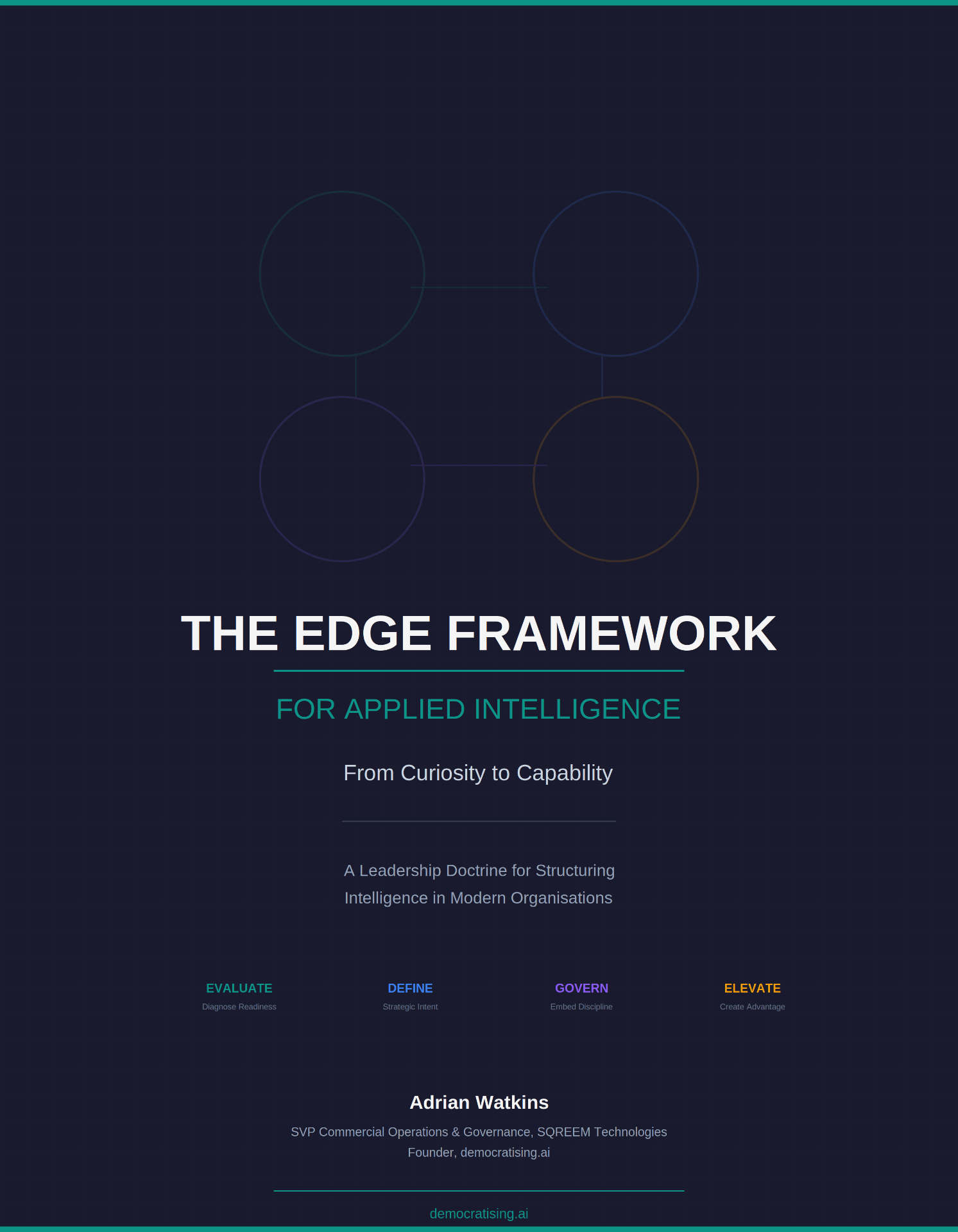
Download the EDGE Framework White Paper
A 19-page leadership doctrine for structuring intelligence in modern organisations
This comprehensive white paper provides the complete EDGE Framework methodology, including:
- The structural problem: Adoption without architecture
- Detailed exploration of all four pillars
- The 12 EDGE tools and how they operationalise the framework
- AI Governance Maturity Model with 5-level assessment
- Implementation guide from assessment to advantage
- Real-world application across startups, SMEs, enterprises, and government
Free download · No signup required · 19 pages · ~2.5 MB PDF
Interested in Applying EDGE?
The EDGE Framework can be applied through diagnostic assessments, executive workshops, or advisory engagements.
A short conversation is often the best way to assess fit and scope.